







Well-Being Without Borders


This audio is generated by AI, so pronunciation and expressions may not be fully accurate. The narration is only in English.
Tokyo as a Global Test Case for Workplace Well-Being
United Health Communication Co., Ltd. (UHC) describes its mission simply: to "create well-being." In practice, that means helping organizations understand what shapes the everyday health of the people who keep them running—and turning that insight into concrete workplace improvements.
"We focus on the well-being of working people," says Shirataki Yasuto, the company's founder and CEO. "People are looking for more than economic success or career advancement. They want to understand what work means, and how it connects to having a good life."
That question carries particular weight in Tokyo. As Japan's largest labor market and one of its most internationally diverse cities, Tokyo concentrates demographic change in a single metropolitan system. According to the Tokyo Labour Bureau, there are 652,251 international workers in its jurisdiction as of the end of October 2025, part of a nationwide total of 2,571,037—the highest on record. In such an environment, workplace well-being cannot be separated from questions of language, culture, and organizational design.
For Shirataki, Tokyo's diversity makes it more than a business location. It becomes a real-world testing ground. "If we can address these challenges in Tokyo," he says, "the solutions can have impact beyond Japan."
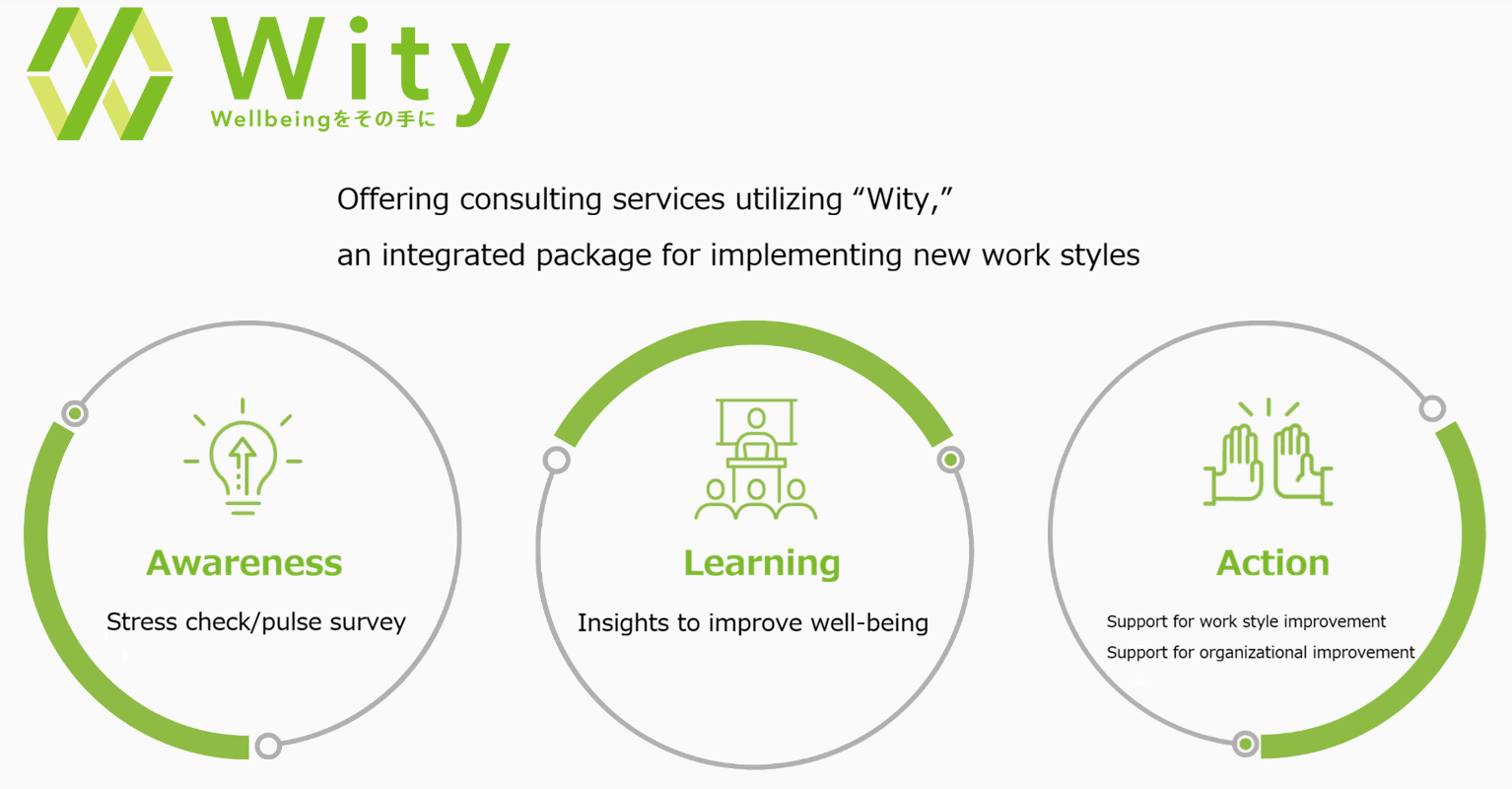
Overview of Wity, UHC's integrated workplace support package, structured around three stages: noticing, learning, and taking action. Image: courtesy of United Health Communication
Designing Support Through Behavioral Science
UHC's approach is rooted in behavioral science—the recognition that knowing what is healthy does not automatically lead to acting on it. In many workplaces, employees understand the importance of balance, communication, and early intervention. Yet time pressure, hierarchy, and unspoken norms often prevent people from taking supportive action. "If people could always behave in ideal ways, we wouldn't have many problems," Shirataki says. "But organizations are complex systems."
A colleague may sense someone is struggling but hesitate to speak up. A manager may want to improve team morale but lack clear information about where issues originate. Behavioral science helps illuminate these patterns and design systems that make supportive behavior easier rather than exceptional.
This philosophy shapes UHC's integrated support package, Wity. While stress checks are widely implemented in Japan, the challenge often lies in what follows. Wity positions itself as end-to-end: assessment, analysis, and structured follow-up. Offered in five languages besides Japanese—English, Chinese, Vietnamese, Nepali, and Portuguese—it aims not merely to measure stress levels, but to identify specific organizational priorities and support managers in addressing them.
Shirataki emphasizes that even within the same company, different teams face different pressures. One group may struggle with workload intensity; another may experience communication breakdowns; another may face environmental factors affecting morale. Making these distinctions visible allows organizations to move beyond generalized concern and toward targeted improvement.
Inclusion Beyond Translation
In a city where hundreds of thousands of workers from around the world contribute to the economy, language inevitably becomes part of the conversation. Emotional nuance is often easiest to express in one's first language, especially in sensitive contexts such as mental health.
Yet Shirataki is careful to frame multilingual support as more than translation. The deeper issue, he says, is inclusion—whether employees feel sufficiently part of the organization to voice concerns.
International workers are not a single category. White-collar professionals may experience stress linked to social distance or a sense of being treated as temporary. On-site workers in manufacturing or field roles may face heavier physical demands alongside communication barriers. Each context calls for a different response.
Across these differences, Shirataki returns to connection as a central theme. Research consistently links strong human relationships to higher well-being. In workplaces, that translates into whether people feel seen, heard, and supported by colleagues and supervisors.
He also points to structural complexities in Japan's dispatch system. "In some cases, the company that legally employs a worker isn't the company where that person actually works every day," he says. "When stress check results show problems, the employer on paper may not have the authority to change the working environment."
That gap, he argues, can leave issues visible but difficult to resolve. To address it, his team prepares reports that dispatch firms can bring to client companies, outlining what workers are experiencing and what improvements may help. The goal, he says, is to position well-being not only as a personal matter, but as something that directly affects workplace stability and performance.
Linking Workplace Practice to Tokyo's Policy Vision
The Tokyo Metropolitan Government's multicultural coexistence guidelines articulate a vision of a society where international and Japanese residents participate together as members of the community. Shirataki sees potential in connecting workplace initiatives more closely with these broader efforts—particularly during onboarding, when newcomers are adjusting to life and work simultaneously. "If there were a more structured process when people first arrive in Japan," he says, "we could support them not only in their jobs, but in how they settle into society."
Company-level initiatives, he notes, can only go so far on their own. A more coordinated approach—linking employment, cultural integration, and mental-health literacy—could strengthen outcomes across sectors.
For Shirataki, mental health is not a specialized add-on but foundational social infrastructure. "Well-being is closely connected to human relationships," he says. In a city as dynamic and diverse as Tokyo, those relationships are constantly being formed and reformed.
His objective remains consistent: build systems that support people before problems become severe, in ways that respect cultural differences while strengthening shared ground. In Tokyo's increasingly international workforce, that approach positions well-being not as an individual burden, but as a collective responsibility.
Shirataki Yasuto
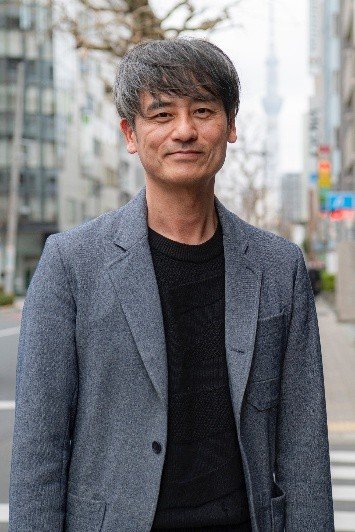
At UHC, he leads the development of evidence-based workplace well-being solutions grounded in behavioral science, including the integrated support package, Wity. He holds an MBA from The University of Manchester.
United Health Communication Co., Ltd.
https://www.uhc.jp/en/about.htmlPhotos by Inoue Katsuya