







Talking Braille Blocks: Creating Cities Where People with Visual Impairments Can Walk Around Freely


This audio is generated by AI, so pronunciation and expressions may not be fully accurate. The narration is only in English.
An Idea Inspired by a Mother with a Rare Disease
Braille blocks are a form of barrier-free infrastructure that originated in Okayama Prefecture, located in western Japan, in 1967. The system combines guided braille blocks, with their four raised lines, and alert braille blocks, with their raised dots, to help people with visual impairments get around safely on foot. It was Takayama Hiroyasu, CEO of W&M systems, who saw the new potential in this familiar piece of infrastructure.
The inspiration came from a pen-shaped sensor developed by lead engineer Chiba Kazuya while he was searching for ways to communicate with his mother, who was living with a rare disease. When the pen was touched to paper printed with special codes, it would play recorded messages such as "I'm hot" or "I'd like some water." This mechanism proved to be a key source of inspiration.
Looking back, Takayama recalls: "I thought maybe we could apply the same mechanism—playing audio when a sensor touches something—to help those with visual impairments get around on foot. From there, we began a long process of trial and error."
User-First Approach to Real-Life Implementation
The initial idea was to turn the white canes used by those with visual impairments into touch pens themselves. A sensor would be attached to the tip of the cane, and audio guidance would be played when the user touched it to the braille blocks. While they succeeded in using the sensor to read information, the dust and dirt that accumulated on outdoor braille blocks rendered it unusable within a day. The sensors attached to the tips of the canes were also prone to breaking or flying off, making the system impractical for everyday use.
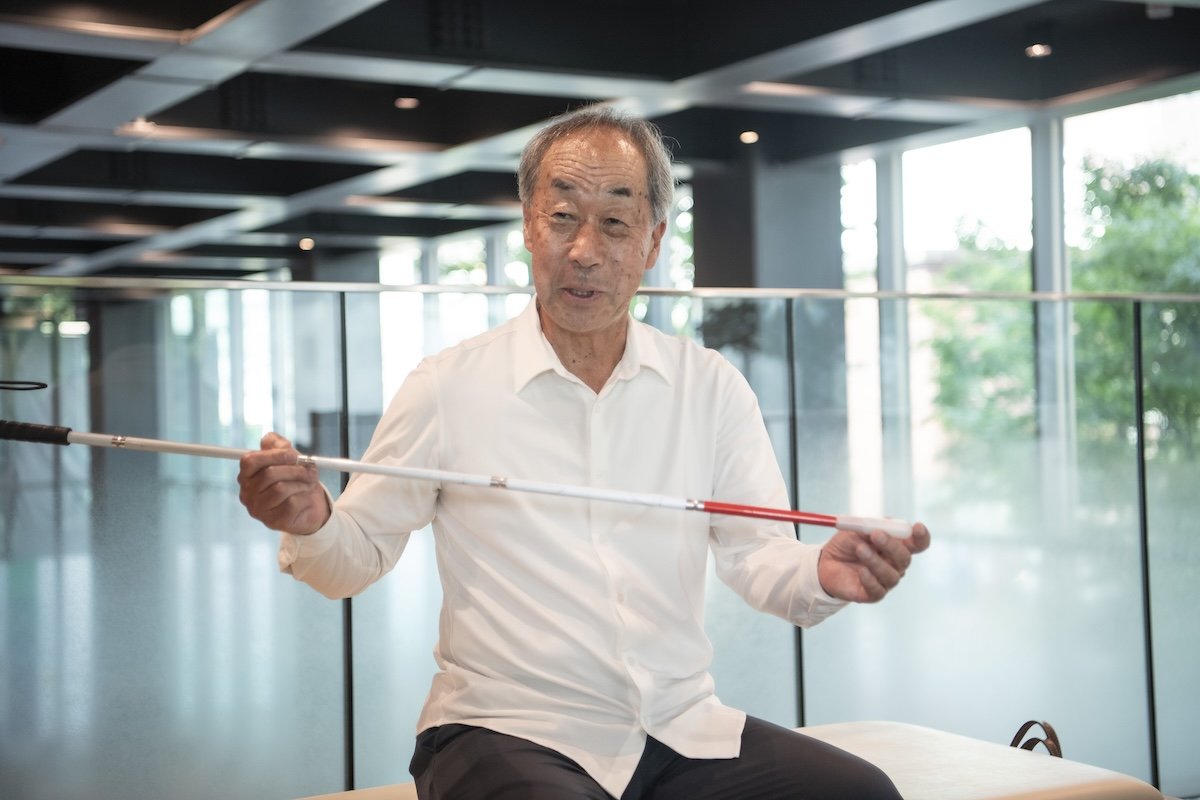
"For those with visual impairments, the white cane is an extension of the body. No matter how convenient or groundbreaking a system may be, it won't work if it's not easy to use."
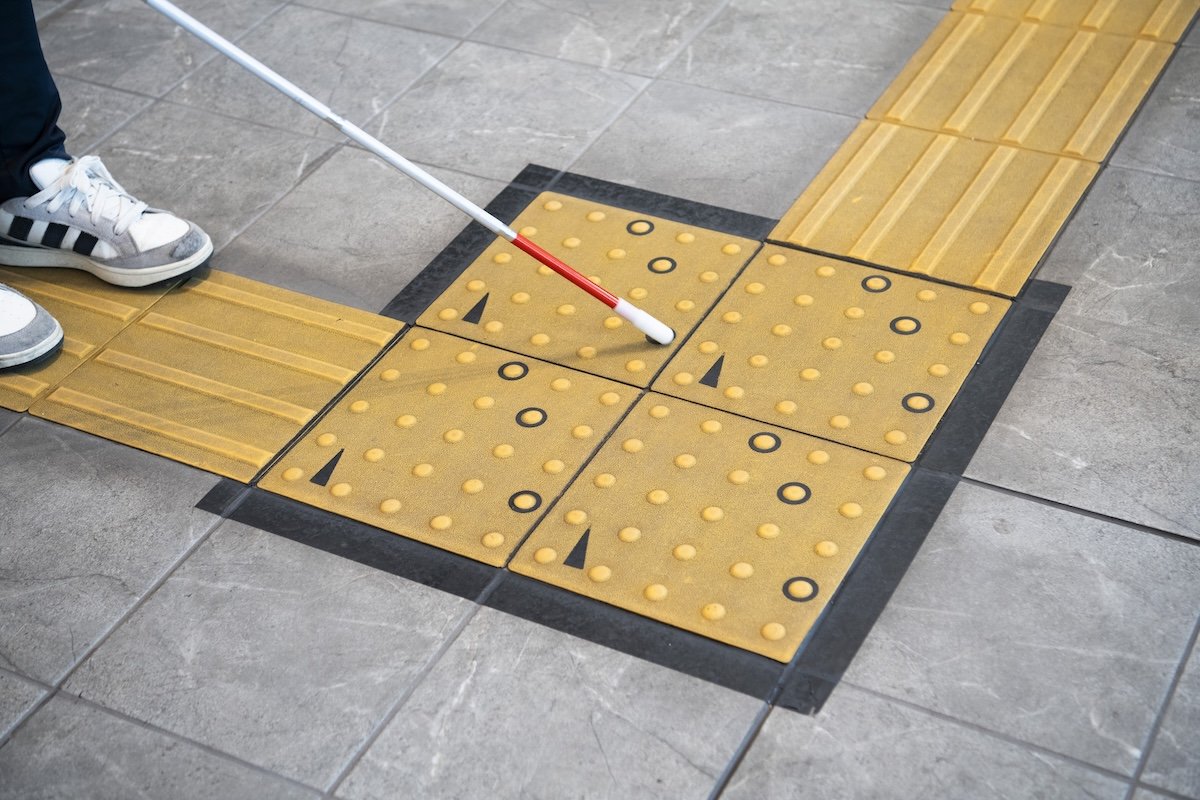
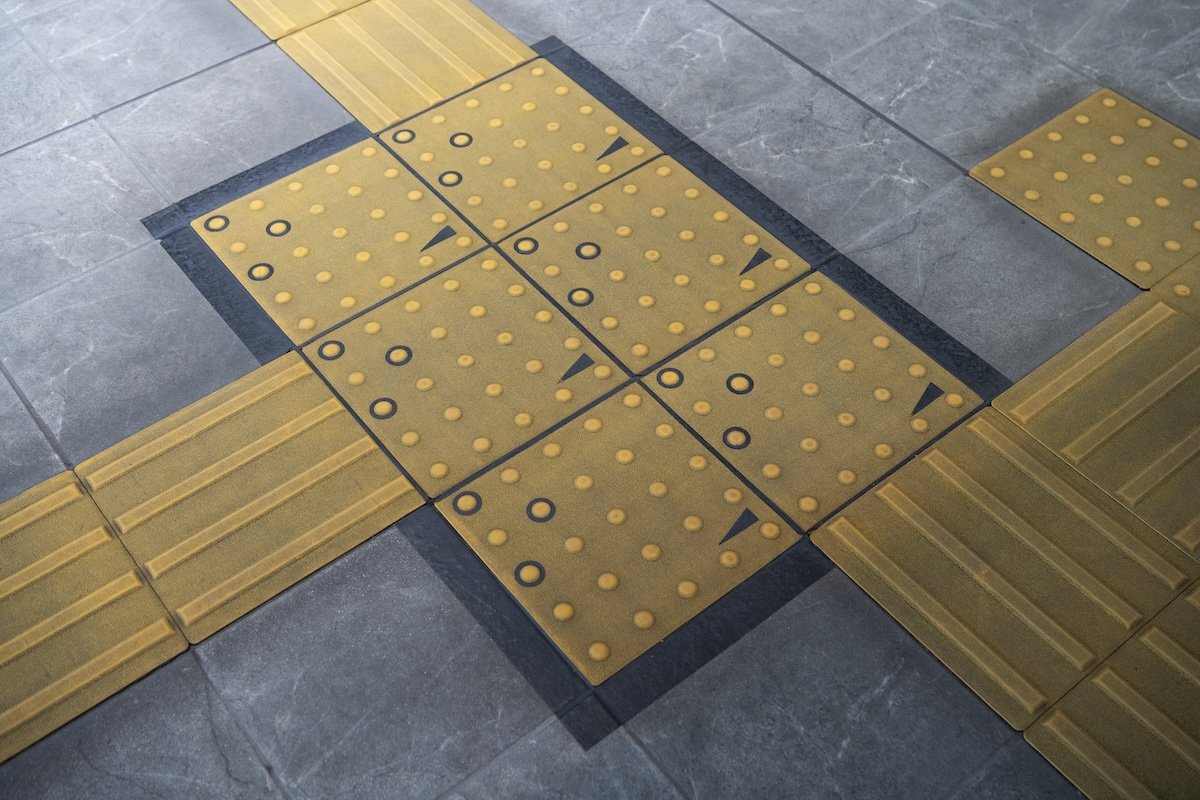
They next turned their attention to the raised bumps on the braille blocks themselves. By adding markings to the 25 bumps (arranged in a 5x5 grid) on the alert braille blocks, they created a code that could be read in the same way as a QR code. By varying which bumps were marked in black, the system could generate over 30 million unique codes.
The prototype developed to bring the concept to life was a cumbersome setup that required users to attach a microcamera to their white cane, connect it by cable to a computer and battery worn on the body, and wear earphones. While the idea and the technology were innovative, participants in the trial noted that the many cords made it tedious to put on, and that it would prevent them from going out spontaneously.
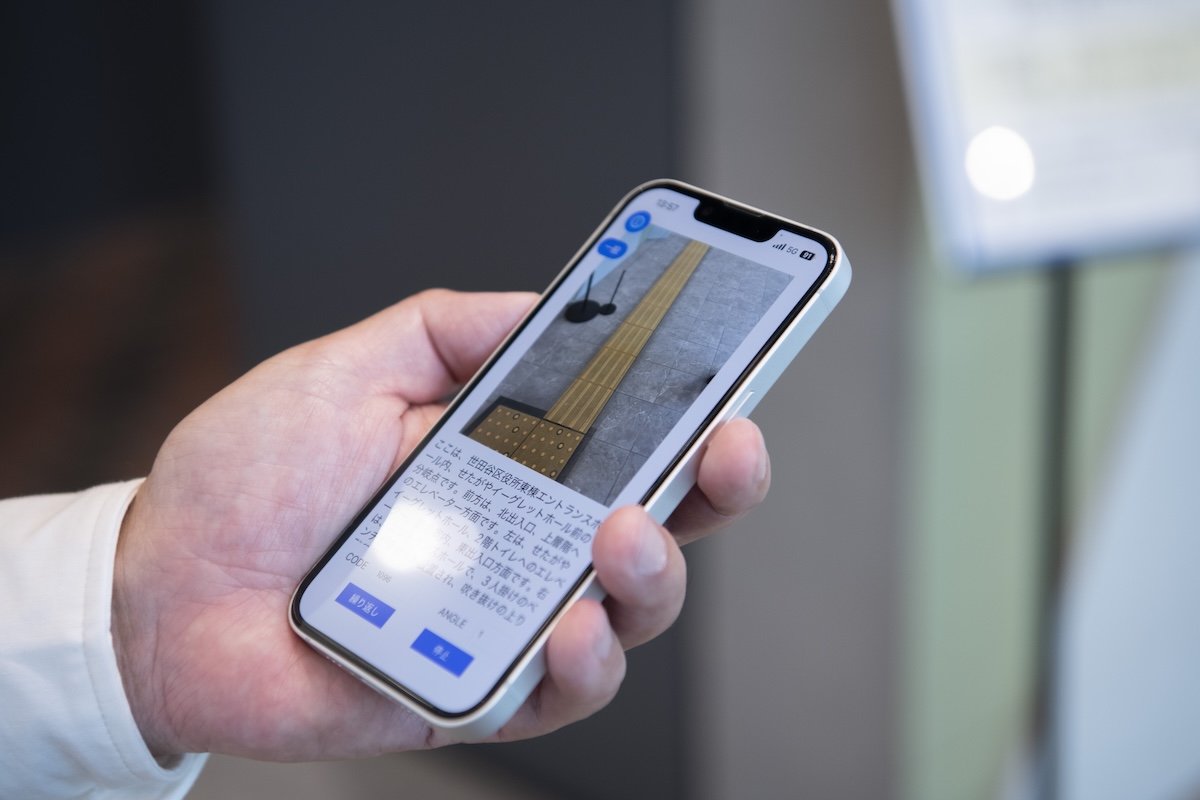
A major breakthrough came when Takayama consulted his friend, Professor Matsui Kunio of the Kanazawa Institute of Technology in Ishikawa Prefecture, on Japan's west coast. Acting on Professor Matsui's advice that the issue could be solved by using a smartphone—which already combines a camera, computer, and telecommunication capabilities—they began joint development. And in 2019, their coded braille block recognition system was released as the smartphone app, Walk and Mobile.
Going Beyond Navigation: The Freedom to Wander
The defining feature of this coded braille block system is that it provides different audio guidance depending on which of the four directions the user is traveling. Map apps that rely on GPS often do not function indoors or underground, and even outdoors can be off by several meters, making it easy to lose one's sense of direction while navigating. By using the braille blocks as a fixed physical reference point, users are able to confirm their location at a centimeter-level accuracy without losing their orientation.
"The greatest challenge for people with visual impairments is when they lose their orientation," Takayama explains. "Close your eyes and spin around a bit, and you lose track of where you're facing. This is something that people with visual impairments experience on a daily basis."
The coded braille blocks also fundamentally differ from route-guidance systems in their design philosophy. While many barrier-free systems are designed to guide users to a specific destination, W&M systems envisions "a society where all people can enjoy the freedom to wander about freely."
"There's a bench over there." "There's a vending machine." "There's a new wagashi (traditional Japanese confectionery) shop." The audio guidance incorporates the kinds of information that sighted people naturally pick up on as they walk, as well as things that can be awkward to ask others about, such as the location of nearby restrooms. The company has received many enthusiastic responses from users, including comments like, "It's like having a map appear in my head" and "It makes me comfortable walking around on my own." Enabling this kind of wandering about in a city like Tokyo, where every walk can bring a new discovery, is likely to help further spread the vision across Japan.
From Tokyo to the Rest of Japan, and Even Disaster Response and Multilingual Support
As of June 2026, coded braille blocks have been installed at 21 locations across Japan, mainly in facilities in Tokyo such as the Setagaya City Office and Shinagawa City Office in Tokyo, as well as sites in Kanazawa City, Ishikawa Prefecture; Shiojiri City, Nagano Prefecture; Tottori City; and Hiroshima City. Because the system provides seamless coverage across indoor and outdoor environments and includes an evacuation mode that functions even when offline, it can deliver audio guidance that helps users navigate to nearby evacuation shelters during disasters.
The company is also exploring applications in tourism through multilingual support. In Kanazawa, there is a pilot project planned for this year to test a "Tourism Mode" that provides information about local sightseeing destinations. This mode is also expected to help address labor shortages among tour guides by offering multilingual audio guidance on nearby machiya (traditional Japanese townhouses), wagashi shops, and other points of interest around Kanazawa Castle Park.
Toward a Barrier-Free Society That Closely Reflects User Needs
The Tokyo Metropolitan Government is advancing barrier-free measures not only in buildings but also on roads and in public transportation facilities, through the Welfare-Friendly Town Development Ordinance, Barrier-Free Building Ordinance, and more.
Takayama, however, points out that improving infrastructure alone is not enough. It is equally important to incorporate the perspectives of the users themselves.
"When people think of visual impairments, they tend to imagine someone who is completely blind. But in reality, only about 10% are totally blind. Around 90% have what's called low vision, meaning they may be able to perceive light but see only blurred images, or have a hard time seeing in the center of their field of vision. The way they see varies greatly from person to person."
With braille blocks, it is important not only to provide physical raised bumps, but also to ensure sufficient contrast with the surrounding pavement by using highly visible colors like yellow. According to Takayama, prioritizing aesthetics and installing blocks in colors similar to the surrounding pavement, or creating overly complex branching routes of braille blocks, can actually cause confusion for those with visual impairments.
"The dividing line between what's truly barrier-free and what's not lies in whether the infrastructure is created with the users themselves, rather than from the perspective of those who can see," Takayama says.

The Ministry of Land, Infrastructure, Transport and Tourism publishes numerical data on the adoption of barrier-free infrastructure in buildings and public transportation. However, W&M systems, in collaboration with the Kanazawa Institute of Technology, is working to develop a Barrier-Free Achievement Index that would measure not only the physical infrastructure, but also the usability of it—factors such as ease of use and public understanding.
"People who have difficulty seeing or hearing, people who use wheelchairs... There are many different kinds of people in our cities. I think that taking small actions, such as paying attention to those around us and offering help when someone appears to be struggling, will be the first steps toward changing our society."
As Tokyo continues to enhance its urban infrastructure, it must also continue to address the question of whether that infrastructure is equally accessible to all. The act of giving braille blocks a "voice" has slowly begun to change the assumptions that have long supported everyday life. As braille blocks, originally developed in Japan, continue to evolve, the hope is that they will spread from Tokyo to the rest of the world as a form of social infrastructure and an embodiment of a new standard for barrier-free accessibility—a society where everyone can enjoy walking around as they please.
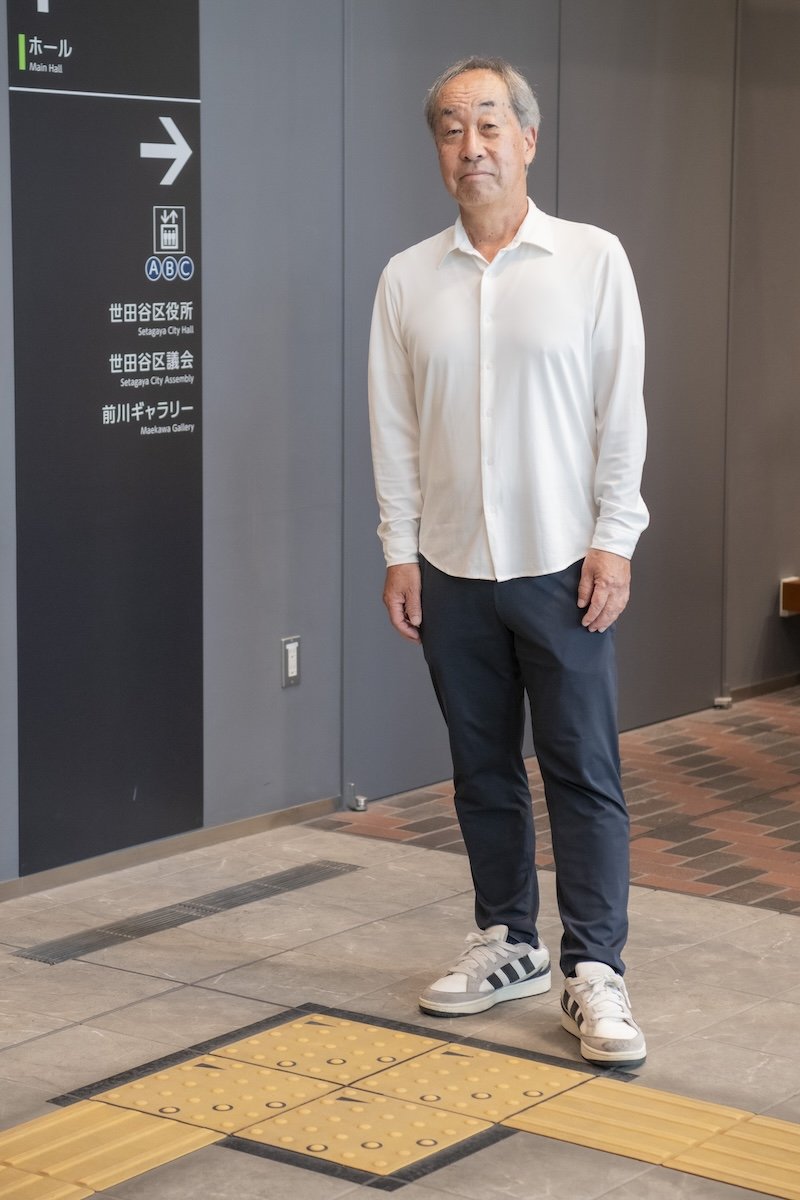
Takayama Hiroyasu
Photos by Inoue Katsuya
Translation by Tanaka Seira